
Assessment
- 01

Sequence analysis and project design
Review domains, signal peptides, transmembrane regions, modifications and stability to define construct, tag and purification strategy.
DeliverableProject and construct plan
RECOMBINANT PROTEIN PRODUCTION
Recombinant protein production, from construct design and expression assessment to purification and quality testing.
Plans tailored to protein properties and intended use support antibody screening, assay development and functional research.

Samples designed for final use
Sample usability
Bacterial, mammalian and insect-cell platforms are matched to structure, modification, yield and intended use.
Tag position, construct, buffer and quality criteria are designed around research, antibody, screening or diagnostic use.
Multi-route strategies address low expression, degradation, aggregation, disulfide bonds, glycosylation and complex domains.
One technical chain connects gene to sample with clear stage feedback and fewer handoff risks.
Purity, endotoxin, aggregation, activity and other tests are configured around intended use.
Microgram- and milligram-scale research production can progress into process optimization and scale-up.
Review domains, signal peptides, transmembrane regions, modifications and stability to define construct, tag and purification strategy.

Complete codon optimization, gene synthesis, expression-vector construction and sequence confirmation.
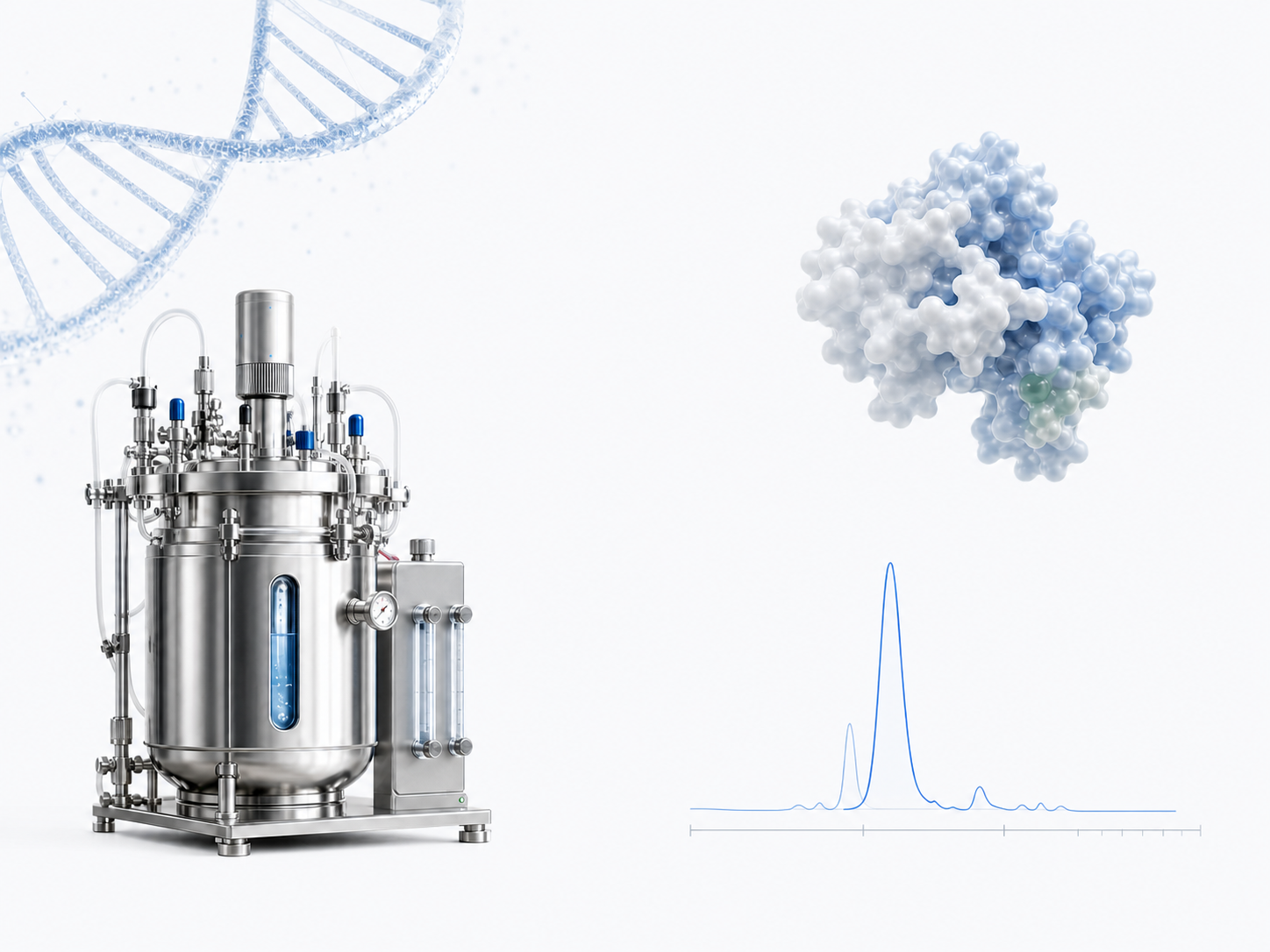
Assess expression, solubility, secretion and stability; optimize host, tag and culture conditions for difficult targets.

Scale culture, harvest and purify through multiple steps, with buffer and storage optimization as needed.

Complete agreed purity, concentration, molecular-weight, endotoxin, aggregation or activity tests and deliver sample and report.
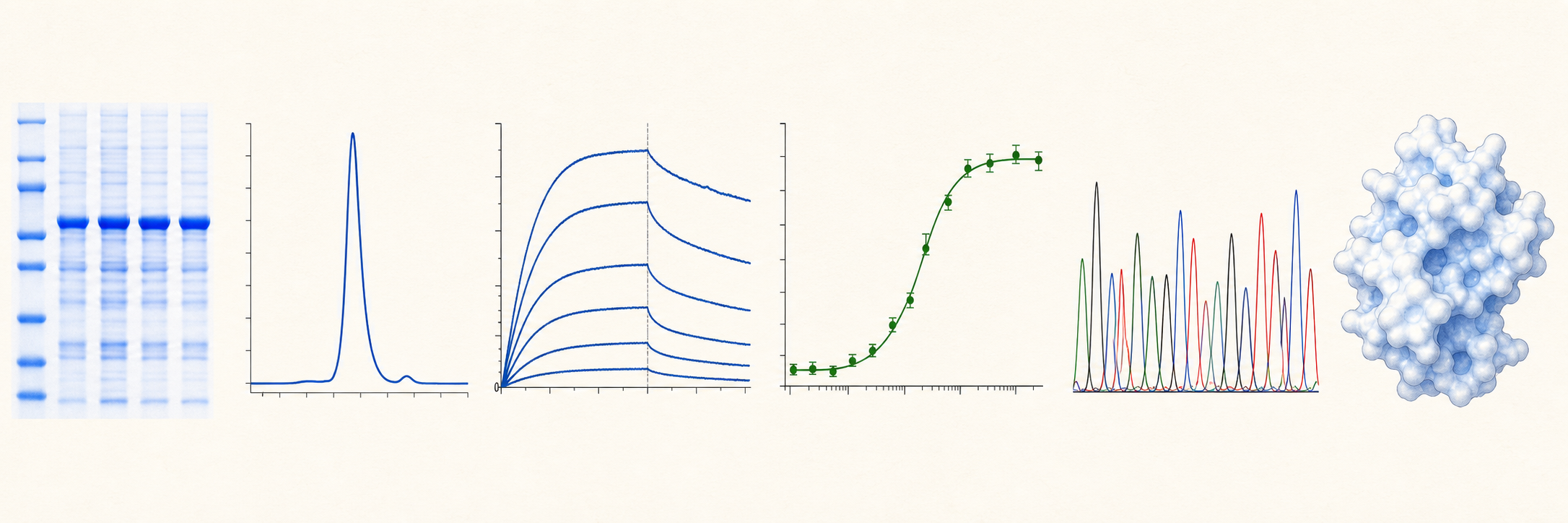
Deliver the project report, agreed test results, and guidance for storage, aliquoting and use.
Service scope & deliverables
Technical scope
Bacterial, mammalian, insect-cell and other custom expression routes.
Execution focus
Match the platform to protein structure, modification needs and intended use.
Final deliverable
Expression plan and purified sample
Technical scope
Cytokines, receptor domains, antigens, enzymes, fusion and multidomain proteins, glycoproteins and membrane targets.
Execution focus
Optimize constructs and systems for expression, stability and folding challenges.
Final deliverable
Target protein fit for agreed use
Technical scope
Configurable SDS-PAGE, concentration, molecular weight, Western blot, SEC, endotoxin, microbial and activity testing.
Execution focus
Agree on testing, aliquoting and storage for the intended use.
Final deliverable
Protein sample, test results and project report
Illustrative project routes show technical choices and verification goals; measured case data is pending.
PROJECT NEED
Produce a human receptor extracellular domain with glycosylation sites and disulfide bonds for antibody screening and interaction studies.
TECHNICAL ROUTE
Define domain boundaries, design a secreted construct, use transient mammalian expression, and remove aggregates through affinity and size-exclusion purification.
VERIFICATION GOAL
Target purity and homogeneity must be confirmed before downstream binding and interaction studies.
PROJECT NEED
The original route produced low expression and inclusion bodies; an antigen suitable for immunization was required.
TECHNICAL ROUTE
Adjust construct boundaries and tag position, screen strain and induction conditions, and compare soluble expression with inclusion-body refolding.
VERIFICATION GOAL
Assess soluble expression and recovery against the requirements of downstream immunization.
PROJECT NEED
Produce an active recombinant cytokine for cell culture and in-vitro functional studies with endotoxin control.
TECHNICAL ROUTE
Use a eukaryotic secretion system, multi-step purification, endotoxin testing and cell-based activity confirmation.
VERIFICATION GOAL
Evaluate purity, endotoxin and cellular activity against the agreed intended use.
Yes. Provide the species, intended use and known structural information so construct boundaries can be discussed during feasibility review.
Selection considers size, modification needs, structural complexity, intended use and budget, with alternatives retained for higher-risk targets.
We can discuss domain boundaries, signal peptides, tag placement and purification needs. Designs involving functional sites or intellectual property require joint confirmation.
Typically we need the target sequence or accession, species, desired format, downstream use, expected sample form and known risk information.
No. Baseline tests and additional analyses are agreed at project start according to protein properties, sample amount and intended use.
Send the target sequence, intended use, purity, quantity and testing requirements for an initial assessment.